header-logo header-logo

THIS ISSUE
Card image

Issue: Vol 174, Issue 8076

21 June 2024
IN THIS ISSUE
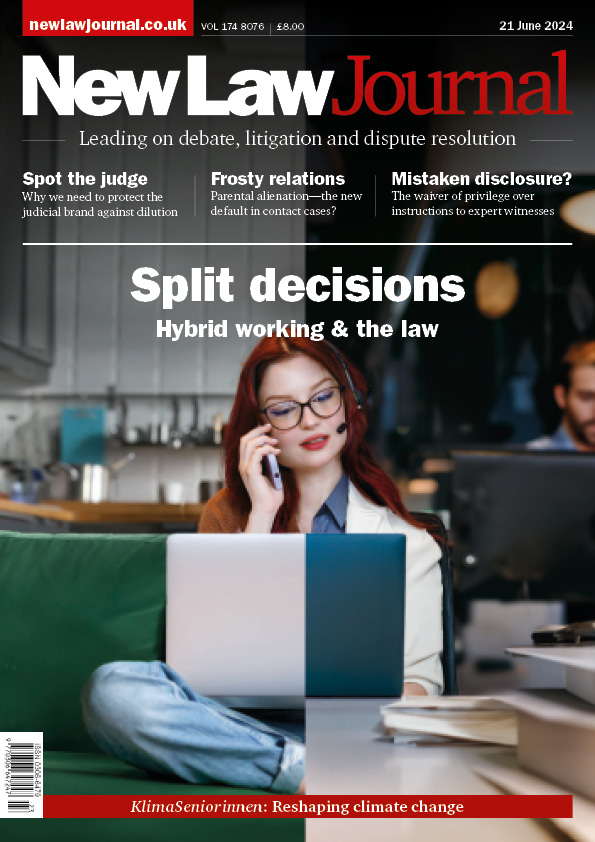
Work-from-home claims are on the rise, & practitioners need to prepare for the fallout, say Rachel Crasnow KC & Imogen Brown
Rules governing the waiver of privilege over instructions to expert witnesses are frequently misunderstood. Chris Pamplin explains why
KlimaSeniorinnen unpacked: David Lawne, Luke Grimes & Ginevra Bicciolo discuss the first successful climate change case grounded in European Convention rights
Jane Chanot warns of the dangers of unexplored assumptions in contact cases
Rakesh Kapila explains why & how expert accountants should check the reliability of evidence in disputes involving businesses
What is the Hague Judgments Convention, & what does it mean for the UK? Janna Purdie provides the answers

‘Parental alienation’ is a term familiar to all professionals involved in child contact cases―but is it being too quickly applied or used as a default position? Could it mask possible welfare issues?

Public perceptions matter, and diluting the judicial title undermines the administration of justice, writes John Gould, senior partner at Russell-Cooke, in this week’s NLJ

NLJ presents an expert witness special in this week’s issue, covering a range of issues of interest to experts and those who hire them or are involved in matters where experts are hired

Show
10
Results
Results
10
Results

MOVERS & SHAKERS

NLJ Career Profile: Maryam Syed KC, Church Court Chambers

NLJ Career Profile: Maryam Syed KC, Church Court Chambers

From childhood dreams of the Bar to some of the country's most challenging cases, Maryam Syed KC explains why she has never stopped standing up for others

DAC Beachcroft—Richard Breavington, Rachel Ford & Daniel Guilfoyle

DAC Beachcroft—Richard Breavington, Rachel Ford & Daniel Guilfoyle

DAC Beachcroft significantly expands Cyber team, hiring three Cyber partners

Browne Jacobson—Professor Clive Kay

Browne Jacobson—Professor Clive Kay

Browne Jacobson appoints senior healthcare leader Professor Clive Kay as strategic adviser

NEWS
The Solicitors Regulation Authority (SRA) has warned solicitors and law firms that using artificial intelligence does not alter their professional obligations, amid concerns over inaccurate legal material and client confidentiality
From forgotten interest claims to case-management appeals, a string of procedural developments offers useful—and occasionally cautionary—lessons for practitioners

Jonathan Fisher KC highlights that it now accounts for around 40% of criminal offences, with roughly 70% involving technology, and argues that the UK cannot simply prosecute its way out of the problem. Detection, investigation and prosecution all require improvement, while different fraud types demand tailored responses.

How forcefully can a litigant criticise a public authority before robust advocacy crosses the line into unreasonable conduct? 
Can a meticulously maintained spreadsheet turn a couple’s informal financial arrangements into legally enforceable obligations? 
back-to-top-scroll